
★ INCLUDED TODAY: THE MAG7 ACCELERATOR — 50 more trades a year. Beta enrollment only. ★
6 Minutes A Morning. Then The Day Is Yours.
The target: grow your account 50% in 90 days.
Brandon's first 90 days doing it: +51.8%.
“I find the wall before the open. Then late morning, once the market has shown its hand, I send you the trade. You copy it, leave it sitting there, and walk away. 6 minutes.”
— Brandon Chapman, CMT · 23 years in the markets
Take one of the 100 beta seats before they're gone.
THE SWITCH 90-Day Challenge is open. $1,990 for 3 years — the third year is FREE. Or $995 for one. There are 100 beta seats, and the first live Mastermind session is Thursday, October 8 at 2:00 PM Eastern.
Secure My Beta Seat$1,990 · 3 years · the third year is FREEHere's What You Saw Today.
Wednesday, September 9. Every trader I know was watching Apple. The first foldable iPhone, the new CEO's first keynote, the whole thing.
I wasn't looking at it. I was looking at one bar on one screen.
Before the market opened that morning I left a trade sitting right underneath that bar. $40. That was the whole risk — not a stop I'd have to honor later, not something I'd have to manage if it went against me. $40 was the most it could ever take from me, and I knew that before I clicked.
Price ran up at the bar and never got there. It came straight back down. The trade finished 2 hours before Apple walked on stage.
Wednesday, 9 September · one contract
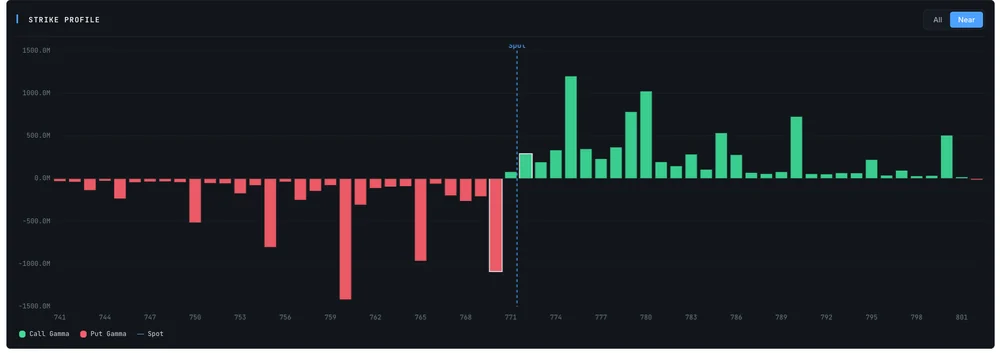
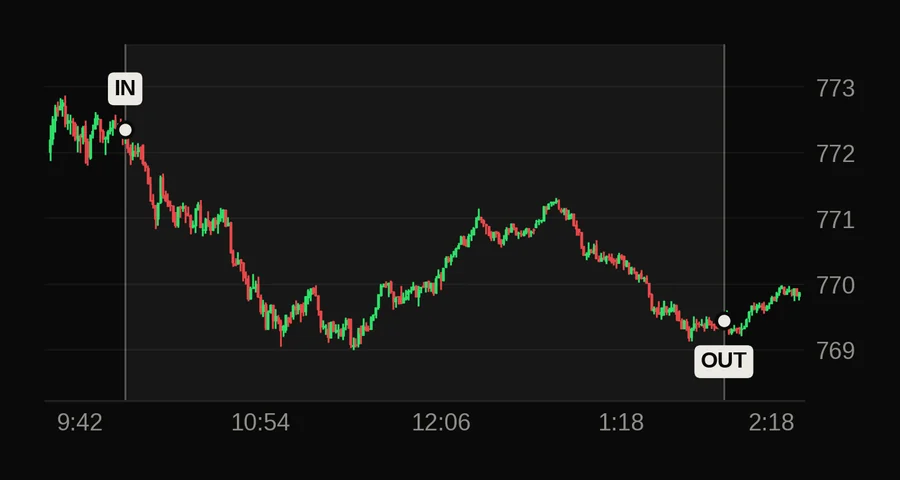
$40 in · $100 out+150%
Then I put the whole record on the screen. Every trade since May 5, winners and losers together.
May 5 through September 9, 2026. 45 winners, 25 losers, 1 flat. Every figure on one contract — the smallest size there is. Past performance is not a guarantee of future results.
I started with the worst number in there, because you'd find it anyway.
11 of those 71 went to zero. Not down a bit. To nothing. If I paid $32 that morning, the worst the day could do was take the $32. It can't be $200 and it can't be $320.
All 25 losses added together came to $870. All 45 wins came to $1,773. The biggest single loss on the record is $60, and I was back the next session.
A loss has a floor. A win doesn't have a ceiling.
19 of the 71 doubled or better. The best one turned $30 into $110.
5 months on that record. All 5 green. May up 17.8%, June up 17.4%, July up 9.8%, August up 15.7%, September up 8.4% with the month still running.
The worst stretch in there took 10.4% off, and it was back inside 7 days.
And the 50% target comes straight off that record.
The first 90 days of it — May 5 to August 3, 40 trades — turned $1,000 into $1,518. Up 51.8%. There are 16 separate 90-day stretches inside the record and 15 of them finished above 50%. The worst one came in at 49.9%, the best at 68.4%.
That's where the target comes from. It sits below what the record actually did, on purpose.
Every one of those trades was one contract, the smallest size there is. That's why the dollar figures look small. The percentage doesn't care how big the account is — every $2,000 traded became $3,806, every $5,000 became $9,515, every $10,000 became $19,030. Same days, same trades, only the size changes.
The same 71 trades applied to each starting balance. Illustrative — not a projection, and not an account anybody held. Past performance is not a guarantee of future results.
So the wall is real. 71 trades say so.
But I made that record the hard way, and in a minute I'll tell you what that means for you.
The Trade Where Everything Lined Up And You Still Lost.
Think of one. Not a dumb trade, and not one where you chased something. Every single thing you were taught to look for was there. You did it right and it went nowhere.
Afterward you went looking for what you got wrong. You were early. You were late. You lost your nerve.
It wasn't any of those things.
For 13 years my job was teaching regular people how to trade. Millions of them. So I got to watch how ordinary people actually trade, up close, every day. And the same thing kept happening.
The setup was good. The entry was fine. They'd done everything right. And the day paid them nothing.
I never had a good answer for those people. That bothered me for years.
What stopped that trade was never on the chart. The chart was the only place any of us were looking.
3 things you were taught that aren't true.
“Everything you need is on the chart.”
It isn't. What stopped that trade was never on it.
“If it didn't work, you did something wrong.”
Some mornings the day was never going to pay you, and you can know that before the open.
“You have to be at the screen to trade well.”
Not when the decision is made before the market opens.
And this isn't a few unlucky people. There's a number for how widespread it is, and it isn't mine. The average person trading options loses 16.4% of what they put at risk.
University of Florida, Warrington College of Business. Naranjo, Nimalendran & Wu, 2023. Retail trade-level data from a major options exchange; average loss of 16.4% over three-day holding periods. Independent academic research — separate from the trade record shown above.
It isn't you. It's almost everybody.
Millions of people, all looking at the same screen. And that screen doesn't show the one thing that decides how the morning goes.
So let me show you the thing that does.
What Actually Stops Price.
One screen, one bar, and why it matters more than the chart.
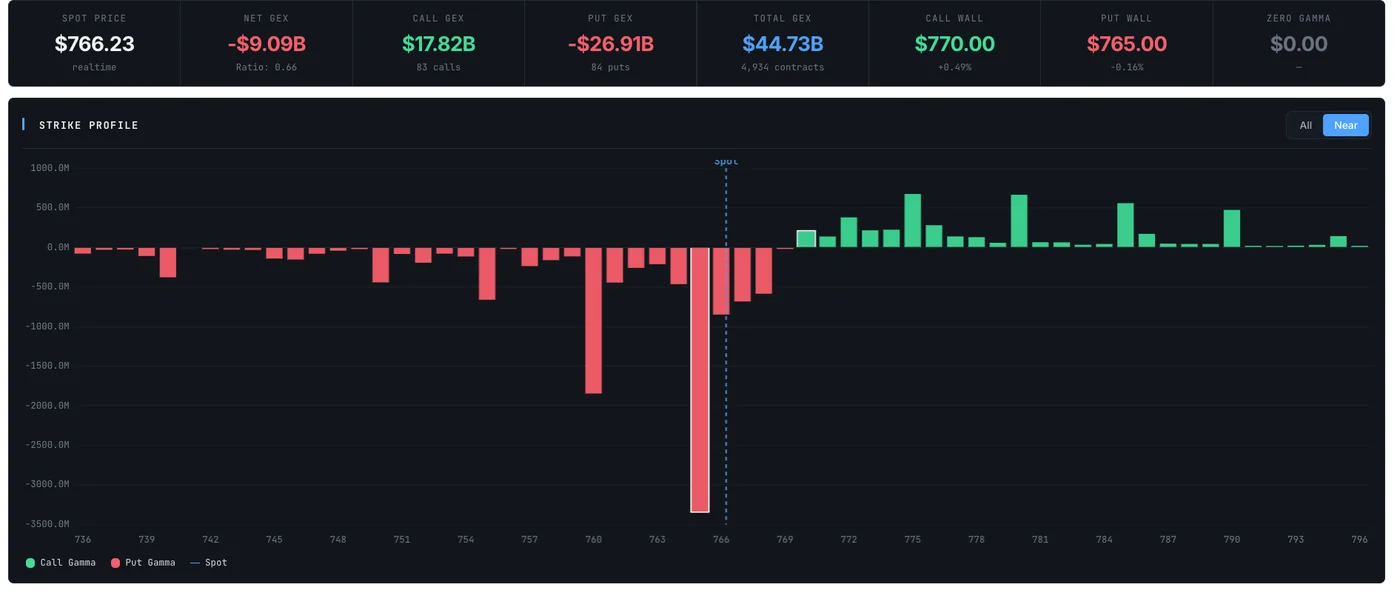
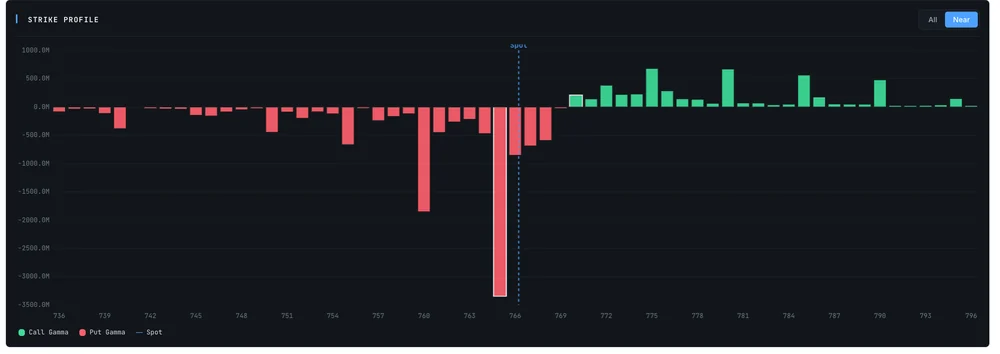
Open the board before the market opens and most of it is flat. Small bars, all about the same height, nothing to look at.
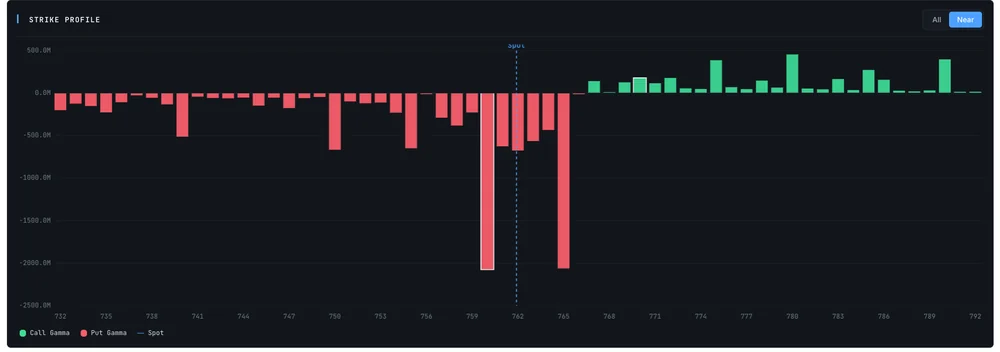
Then there's one that isn't. It towers over the rest, and the bars either side of it are nowhere close. That's the whole thing you're looking for in the morning. One bar.
That tall bar is a wall of bets, piled up at one price.
Every day people place bets on where price is going, and those bets pile up. At most prices there's almost nothing there. At a few prices there's an enormous amount.
Run into an elephant and the elephant isn't going anywhere. You are. Back the way you came, and the faster you were going, the further back you end up.
Here's why the wall stops price. Below it, the biggest firms in the market are buying. The moment price reaches it, they switch to selling. They don't decide to do that — what they're already holding leaves them no choice.
That switch is what stops price cold. It happens every single day the market is open, and almost nobody can see it coming.
The data underneath it is public. Anybody can buy it tonight, and it's useless — thousands of rows with no shape, no picture, and nothing telling you which row matters.
Turning that into one screen you can read in 4 seconds is the part nobody had done. TheoTrade put a team on it for 6 months.
Now you know why it's called THE SWITCHBOARD. It shows you where the switch is.
It Shows Up Again. And Again.
4 mornings in a row. Same board, same tall bar, same 3 steps.
This is the part I'd want to see if I were you. One good morning doesn't tell you much. What matters is whether it happens again the next day, and the day after that.
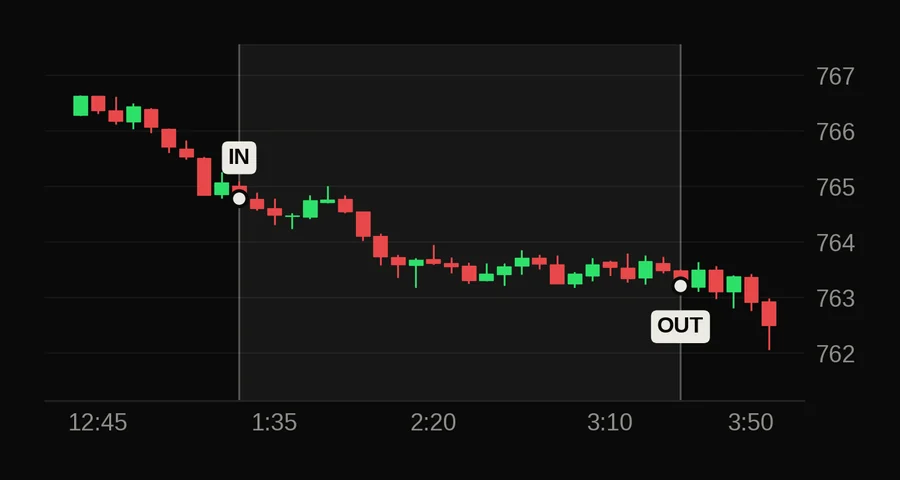
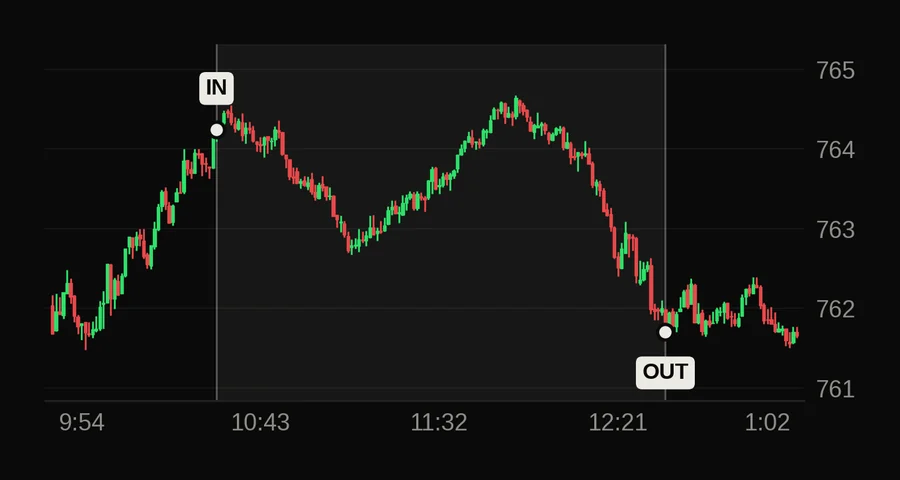
Here are 4 of them back to back. On the left is the board before the open each day, and you can pick out the tall bar in about a second without knowing anything about options. On the right is what price did about it, with the entry and the exit marked.
Thursday, 20 August
$29 in · $80 out+176%
Tuesday, 1 September
$35 in · $100 out+186%
Thursday, 4 September
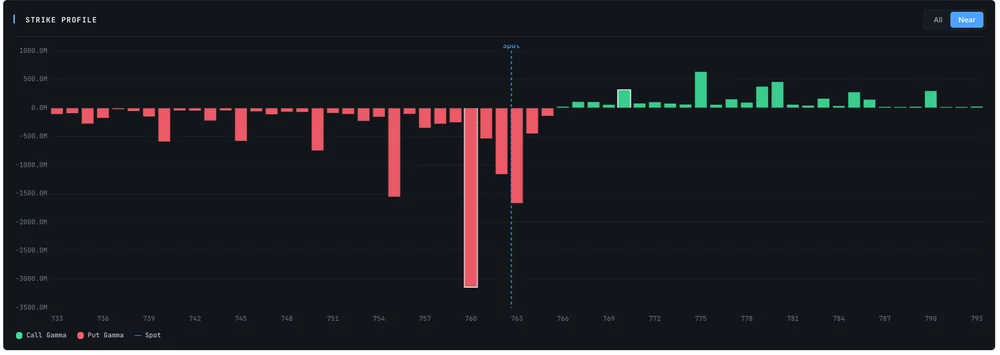
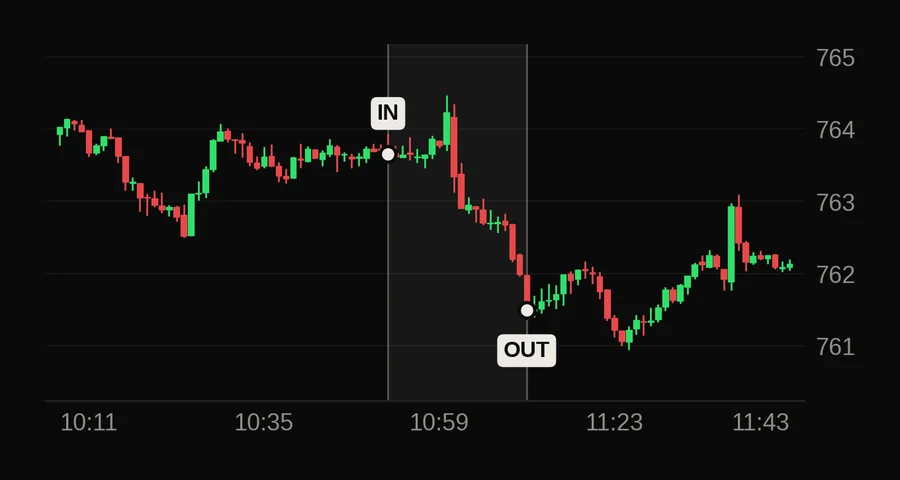
$32 in · $0 out−100%
Wednesday, 9 September
$40 in · $100 out+150%
Every figure on one contract — the smallest size there is. 4 of the 71 trades on the record, shown consecutively, winners and the loser together. Past performance is not a guarantee of future results.
The third one didn't work. Price never reached the wall, so the trade ended up worth nothing and it cost $32. That was the whole risk, and it was decided before the order went in.
That's the shape of it. Most of them work, some of them don't, and the ones that don't can only take what you put in.
Now I Need To Be Straight With You.
A lot of those 71 trades, I placed during the day. Not at the open.
I was sitting there. Watching the board. Watching price come toward the wall. And when it got there, I put the trade on.
That worked. Those trades are the record you just looked at, and they proved the wall.
They also showed me the flaw.
A screen that tells you where the wall is doesn't give you your day back if you still have to sit there waiting for price to reach it. You've still lost the whole day. You've just lost it looking at a better screen.
And the reason I had to fix it isn't a trading reason. I coach my kids. Games are in the afternoon and practice is straight after school. You can't do that and sit in front of a screen from 9:30 to 4.
So I had 2 choices — give the trades up, or work out how to place them and walk away. I wasn't giving them up.
So there are 2 ways to trade the same information. The first is the way I did most of those 71 — find the wall, sit at the screen, wait for price to get there, and put the trade on when it arrives. It works. It also takes your whole day.
So the question I had to answer was this: how does somebody with a job take the same trade, without being there when price shows up?
Here's what I came up with, and it's the part you're buying.
You place one order late morning, and then it just sits there. If price reaches the wall, it buys you in. If it gets to your target, it sells you out. You don't have to be at the screen for either one.
Same wall. Same setup. A different way to execute it — and it gives you your morning back.
See It. Place It. Leave It.
3 steps. 6 minutes. And you are never trying to catch a moment.
1
See it
The trade lands late morning, with the wall on it.
You open the board and there's the tall bar, with price sitting underneath it. You're not hunting for it and you're not deciding anything. You're just seeing the one price that matters today, so when my trade arrives you know why it's there.
2
Place it
One simple order, late morning.
It buys in at the wall and it sells itself at your target. Both orders go in at the same time and both of them wait.
You copy the strikes, the price to pay and the exit straight across from what I send you.
3
Leave it
Screens off. You're not there either way.
If price reaches the wall, the trade enters. If it reaches the target, the trade exits. If it never gets there, nothing happens.
Nothing is held overnight. And if nothing has happened by 2pm, it is one tap on your phone and the order is gone. You are out for nothing, because you were never in.
6 minutes a morning. About half an hour a week. And none of it is spent waiting for price.
One thing worth being clear about, because it's the whole shape of the 90 days.
On day one I do the finding. The wall is marked, the trade is written out, and your job is to copy it across. Nobody's asking you to spot anything on your first morning.
Then over the 90 days I teach you to read the board yourself — which walls count, which ones to leave alone, and why I take one and not another. By day 90 the goal is that you open the board and see it without me.
What 6 Hours A Day Actually Costs.
Right now most people trade one way. Hours in front of the screens, the whole market day. Taking trades, watching trades, watching them again.
6 hours a day across 250 trading days comes to 1,500 hours a year. That's 37 full-time workweeks, in front of screens.
6 minutes a morning across the same 250 days comes to 1,500 minutes. 25 hours against 1,500.
You don't pay for those 6 hours with money. You pay with your day.
Picture Tomorrow Morning.
It's late morning. One message arrives, and the trade is written out inside it. Where the wall is, exactly what to buy, what to pay for it, and the price to sell it at.
The morning trade
IndexSPY
Where the wall isMarked on the board
What to buyBoth strikes, written out
What to pay$0.40 or less
Sell at$1.00
Most it can cost$40
When it landsLate morning, usually 10:30 to noon
Time to place itAbout 6 minutes
Illustrative — this is the format the morning trade arrives in. Figures are from the September 9 trade above.
You open your brokerage app. You copy it across exactly as it's written. If you can copy and paste, you can place this.
It is a resting order at a price, not a moment you have to catch. You have a couple of hours to get it in, and once it is in it works whether you are watching or not.
And here's the part that takes people a while to get used to — you just leave.
Work. The school run. The gym. Whatever it is for you. The orders are already sitting there and the market does the rest.
Same market. Same account. Different day.
Real Members. Real Results.
Unsolicited. Nobody asked them to say this.
“I got in at 25 cents and closed it at $1.15.”
— B. Blair, Goodyear, Arizona
Member's own words, lightly edited for length. Individual results vary and are not typical. Trading involves risk of loss.
“Woohoo! Just got into SPY for 60 cents and sold it for $2.20, based on your strategy yesterday.”
— B. Solomon, Royse City, Texas
Member's own words, lightly edited for length. Individual results vary and are not typical. Trading involves risk of loss.
“Bought this for 25 cents, and just closed it for 92 cents. Probably too early, but I am happy.”
— A. Hess, Mission Viejo, California
Member's own words, lightly edited for length. Individual results vary and are not typical. Trading involves risk of loss.
Everything That's Yours Inside THE SWITCH 90-Day Challenge.
Total retail value: $13,285
Let me walk you through everything you get.
The Morning Trade
Retail value: $2,997
Every morning I send you the trade I'm taking. The same one I'm putting on myself.
Where the wall is. What to buy. What to pay for it. The price to sell it at. No hunting, no scanning, no guessing what I'm looking at.
It comes to you late morning, usually between 10:30 and noon. You never go looking for it.
On the rare morning something needs changing, I'll send you a clear update. Most days there's nothing.
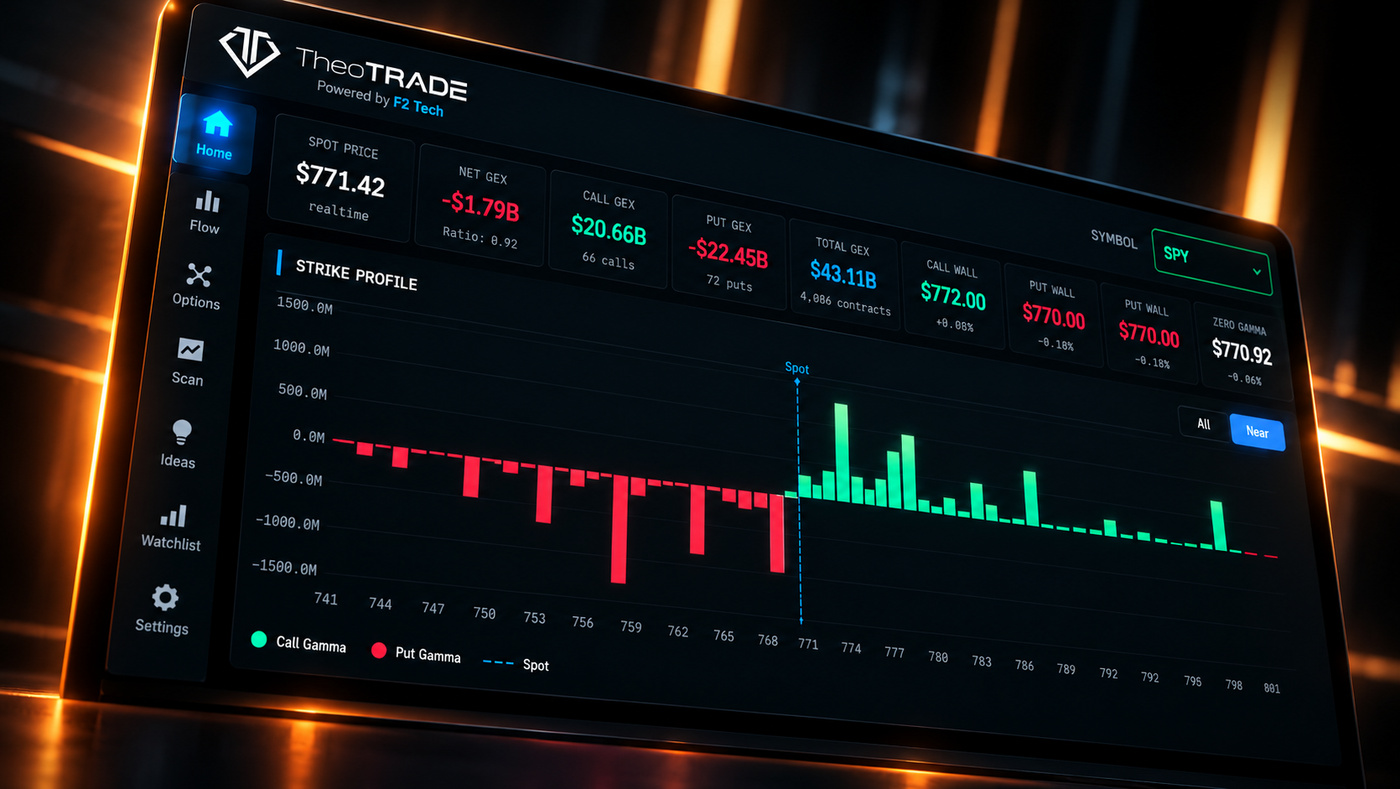
THE SWITCHBOARD
Retail value: $4,997
I don't want you dependent on me forever. If all I ever did was send you the trade, you'd never know why I was taking it.
So you get the board. The same screen I'm looking at every morning, not a summary of it.
You see the wall. You see where price is going to stop. You see why the trade exists. I'm not asking you to take my word for any of it.
It tells you 3 things before the open: where the wall is, whether it's big enough to hold, and whether today is worth trading at all. Some mornings there's nothing there, and knowing that early is worth as much as the trade.
THE SWITCHBOARD isn't on the TheoTrade website and this is the only way onto it.
The 5-Week Mastermind
Starts Thursday, October 8 at 2:00 PM Eastern
Retail value: $2,997
This is a curriculum, and it runs in order, one piece at a time.
Reading the board and what each part of it is telling you. Which walls count and which ones to leave alone — that one is most of the skill. Building the trade: strikes, what to pay, where the exit goes, and why. Sizing it from your own account instead of mine. What to do with a trade that didn't come off.
Then you bring me your board and I read it with you, out loud.
My goal isn't that 5 weeks from now you're still waiting for me to tell you what I see. It's that you open the board and see it yourself.
The Trading Room
Retail value: $1,997
So you're not figuring this out on your own.
When something doesn't make sense, you ask the day it happens. You can see what everybody else did that morning. And there's somewhere to go when it doesn't look right. Bring me a board and I'll read it with you. Ask me anything — a trade, your account, something you didn't follow.
Watching somebody do this in front of you is the fastest way there is to pick it up.
The Getting Started Series
Retail value: $297
Before any of the rest of it, let's get you set up.
How to read the morning trade and find it in your account. How to place it and how the orders work. Never placed one of these before? You start here.
Watch it once. You're ready for the first morning.
The MAG7 Accelerator
Apple · Microsoft · Nvidia · Amazon
Google · Meta · Tesla
Beta enrollment only
Plus 1 extra trade every week — around 50 more trades a year.
Retail value: $2,997
Everything I've shown you so far is one index. This is the same board, pointed at the 7 biggest names in the market.
Apple. Microsoft. Nvidia. Amazon. Google. Meta. Tesla. The stocks the whole world talks about, and most likely the ones already sitting in your retirement account.
Every one of them has a switch underneath it.
Same as the index. Below the wall, the biggest firms in the market are buying. The moment price reaches it, they turn into sellers. It happens on these names every single day the market is open.
And almost nobody trading them knows it's there. They get the company right, they get the direction right, and the day still takes their money. No wonder it feels impossible.
You'd be looking at the switch before the open, on the names everybody else is guessing at.
Same 6 minutes, too. One order late morning, then the day is yours. These are the biggest companies on earth and you don't have to sit and watch a single one of them.
And it isn't just the board.
One more trade. Every week.
Every week I send you one more trade, on these names. Same as the morning trade — the strikes, what to pay, where the exit goes. You take it or you don't. Nothing says you have to.
~50 more trades a year
On top of every morning trade you're already getting.
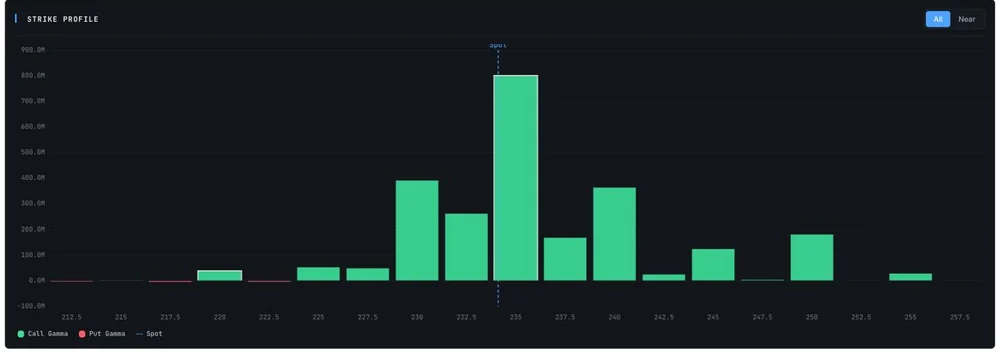
Here's one. September 4, Nvidia. The tall one was at 235 and price was sitting right underneath it at 234.15. Same picture you've been looking at all the way down this page, with a different name on it. So I took the same 3 steps.
Thursday, 4 September · Nvidia
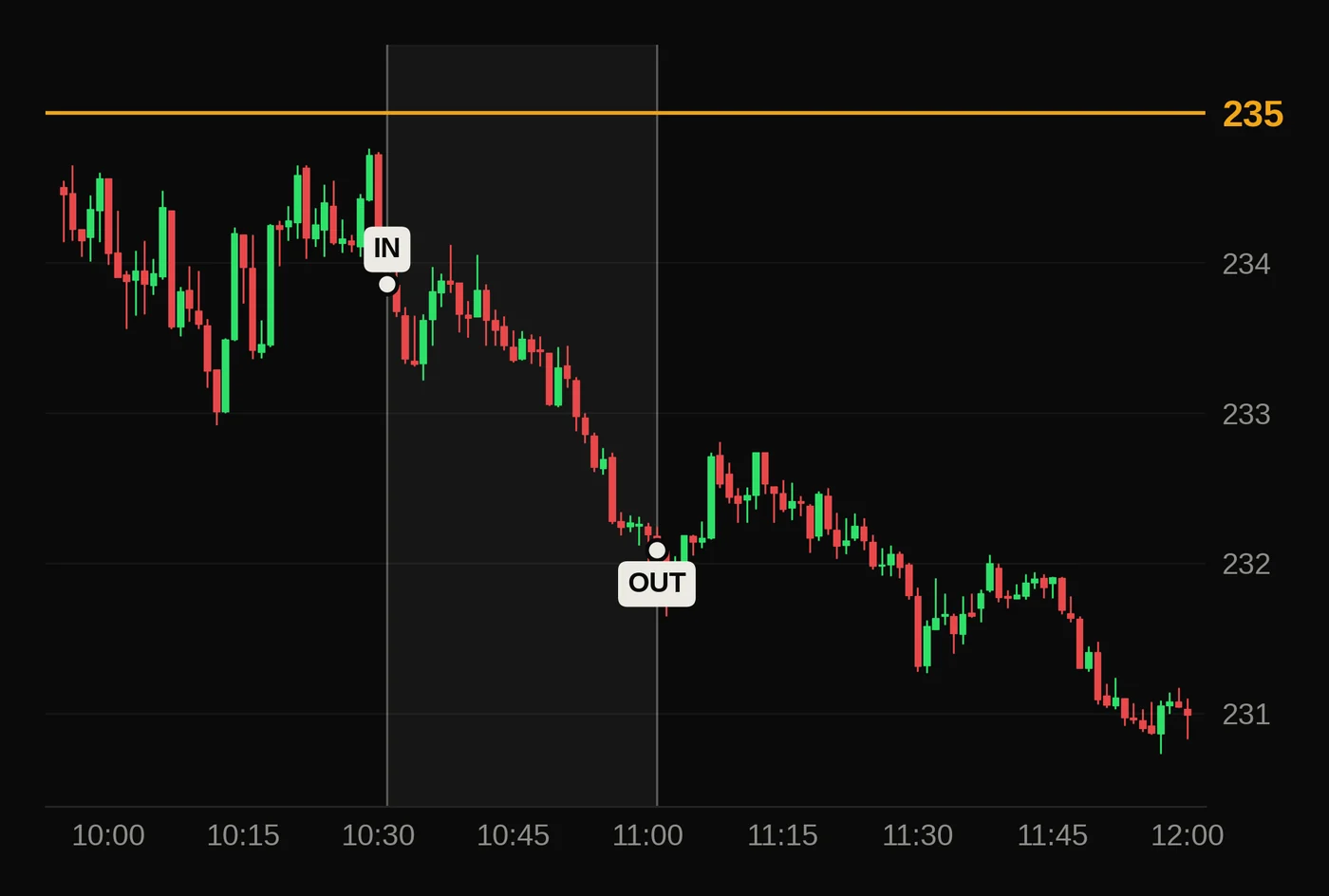
$40 in · $90 out+125%
It gapped up, ran straight at that bar and got to 234.66. That's 66 cents away, and it never got there. Then it rolled over and came back 3.5 points through the middle of the day.
I want to be straight about one thing. The record I showed you — all 71 trades — is on the index. These MAG7 trades are new. Same board, same read, and you would be watching me build that record from day one, right alongside me.
Learn to read the board and you can point it at the names you already follow — and see the thing underneath them that almost nobody else does.
So Add It All Up.
Total value
$13,285
The 5 pieces above, bought separately
Plus, beta enrollment only: The MAG7 Accelerator — the board on 7 names, and 1 extra trade a week. Another $2,997, and you don't pay anything extra for it.
You are not paying that.
And that's all 5 together. Now take one of them on its own.
THE SWITCHBOARD isn't for sale anywhere. It isn't on the TheoTrade website. There's no page for it and no price on it. This is the only way onto it.
On its own
$4,997
THE SWITCHBOARD, and there is nowhere else to buy it
So what should this cost?
I could charge $995 for one 90-Day Challenge. One Challenge. 90 days. $995. And nobody would call that unfair.
One Challenge · 90 days
$995
And nobody would call that unfair
Two Ways In. Pick One.
Here's what I'm doing instead. One full year is $995.
Then there's the deal I put together for the people who go first.
You're the first 100 people ever to log into this screen. You'll tell me what you love and what doesn't make sense, and the next version gets built out of what this group tells me. So here's what I'm doing for that group, once.
3 full years. 12 complete 90-Day Challenges. Every morning trade, every trading day, through 2029. THE SWITCHBOARD, the 5-Week Mastermind and the Trading Room, all of it.
3 years at $995 is $2,985. You pay $1,990.
The third year is FREE.
Option 1 · One full year
$995
4 complete 90-Day Challenges. Every morning trade, THE SWITCHBOARD every trading day, the 5-Week Mastermind, the Trading Room and the Getting Started Series.
One payment · No auto-rebilling · About $2.73 a day
Same money as one Challenge. You get 4 of them.
Or, if you're going to be here anyway — it gets better.
Bought separately: $13,285
Option 2 · Three years · Beta enrollment
$1,990
12 complete 90-Day Challenges, through 2029. Everything above, for 3 years.
One payment · No auto-rebilling · The third year is FREE · $1.82 a day
$995 × 3 years = $2,985. You pay $1,990 and save $995 — a whole year, FREE.
Grab a napkin, because I want you to see what 3 years actually means.
12 complete 90-Day Challenges. Around 750 market mornings. 3 years of the board, 3 years of morning trades, 3 years in the Trading Room, and the 5-Week Mastermind to teach you the whole thing.
$1,990 across 3 years is $1.82 a day — and the third year of it is FREE.
No renewal next September. No decision to make again next year. No invoice landing in your inbox asking whether you want to stay. You decide once and you're with me through 2029.
Two Guarantees. Both Ironclad.
You don't have to decide today whether this is right. Just take it for a test drive.
Guarantee #1

The 30-Day Money Back Guarantee.
Get in, log into the board every morning, watch the trade go out. Place one if you want to. You don't have to place any.
Decide inside 30 days that it isn't for you and one email brings every dollar back. No forms. No argument.
Guarantee #2
The Extended 90-Day, 10-Trade Guarantee.
I'll go one further. Give it a fair test — take 10 trades inside your first 90 days.
Still not satisfied? Send us your trade record and every dollar you paid comes back.
Both clocks start on Thursday, October 8 — the first live Mastermind session, not the day you buy.
That matters, and it’s in your favor. You’re in tonight. The morning trade starts coming to you right away, the Getting Started videos are there the moment you join, and the Trading Room is open. So you’ll have been using the real thing for weeks before the refund window even starts counting.
Both guarantees cover you whether you choose 1 year or 3.
Two ways out. The risk of finding out sits with me.
You Will Never Be Auto-Billed. Ever.
I know what people worry about when they see the words "3 years."
No auto-renewals. No card quietly charged in the background. No surprise invoice showing up 3 years from now. That is not how I do business.
Here's exactly how it works.
Your one payment covers your full term — 1 year, or 3. When it's up, we get in touch and ask whether you'd like to carry on. Your call, every time.
And if the answer is no, that's completely fine. Nothing to cancel, nothing to argue about, no hard feelings.
Nothing is ever charged without you saying yes first.
You have my word. — Brandon
100 Beta Seats. That's It.
That isn't a marketing number. It's how many people I can actually listen to while this is new.
I want to know what's confusing, what's missing, what you'd change. I can do that with 100 people. I can't do it with a thousand.
THE SWITCHBOARD isn't new. I've been trading off it for months — that's where the 71 trades come from. Nobody else has logged into it. You'd be first, and you get your private login today.
I've been the only person looking at this thing, which makes me the worst judge of whether it's clear. The next version gets built out of what this group tells me.
When the 100 are gone, the beta closes. The FREE third year goes with it, and so does the MAG7 Accelerator.
The first live session is Thursday, October 8 at 2:00 PM Eastern.
You're in the board tonight — log in and look at tomorrow's before you go to bed. You don't have to do anything with it.
Tomorrow late morning, the trade comes to you and you place the order. About 6 minutes later you are done for the day.
The beta closes when the 100 seats are gone, and it closes for good on Thursday, October 8 when the Mastermind starts. Whichever comes first.
There's a wall sitting on that board every morning whether you're on the list or not.
The Questions I Know You're Asking.
“I'm not sure I'm good enough for this.”
There's nothing to be good at. You're not reading a chart. You're not picking a direction. You're not timing anything. You don't need an opinion about the market, and I don't have one either.
Smart has nothing to do with it. The people who struggle are the ones who can't sit still.
“I've never placed an options trade in my life.”
Then you start with the Getting Started Series, which exists for exactly that. How to read the morning trade, how to find it in your account, how to place it, and how the orders work.
The trade arrives spelled out. You copy it across. You're never staring at a blank screen wondering where to begin.
“Do I need a special account?”
Just simple options approval. If you haven't got it, we'll help you get it. Most people are approved inside a day or two.
“Can I do this in an IRA?”
Yes. The most one of these can cost you is what you paid for it, and that's the kind of trade brokers generally allow inside an IRA.
What you need on the account is the right options approval. That part comes down to your broker and the level they've given you, so if you're not set up for it yet, tell us and we'll help you get it done.
“How much do I need to start?”
Enough to place one of these without it keeping you up at night. The trades on the record cost $28 to $70 each.
Every figure I showed you was one contract, the smallest size there is. Most people start at one and grow into it when they're ready.
“What if I'm working during market hours?”
That's exactly why it's built this way. The trade comes late morning and you have a couple of hours to place it. It is a resting order at a price, not a moment you have to catch. If price reaches the wall it enters. If it reaches the target it exits. You don't have to be there for either part.
“What if I miss a morning?”
You miss a trade. There's another one tomorrow. Nothing about this runs on a hair trigger.
“How do I know these results aren't cherry-picked?”
Because I led with the losers. 25 of them, 11 that went to nothing, the total in dollars and the worst single one.
71 trades, every one of them one contract, May 5 through September 9. The record wasn't built to sell you anything. It was built because I needed to know whether I was right.
“Will you charge my card again in a year?”
No. There is no auto-rebilling on either option.
Your one payment covers your full term. When it runs out we get in touch and ask whether you want to carry on, and if you'd rather not, that's the end of it. Nothing is ever charged without you saying yes first.
“What happens after the 90 days?”
Another Challenge starts. A year gets you 4 of them, 3 years gets you 12. The board, the morning trade and the Trading Room keep running the whole time.
This Is Bigger Than One Trade.
The world is getting harder. You feel it. Everybody feels it.
Inflation isn't a headline. It's your grocery bill. It's the look on your face when you check the account at the end of the month and wonder where it all went.
And the thing most people do about that is hand over more of their day. More hours at the screen. More trades. More watching.
I did that for years. It cost me my mornings and it didn't answer the question that was bothering me.
What I want for you is the other thing. One decision, 6 minutes, then your day back.
Tomorrow morning, millions of people will look at a chart. A hundred people will be looking at the one price where the buying turns into selling — and they’ll know it before the market opens.
6 Hours. Or 6 Minutes.
Same person. Same account. Same market.
6 Hours
Opens the chart and goes hunting for a setup.
Guesses which way price goes, then hopes.
Sits there all morning waiting for the entry.
Phone out at every red light. Again in the parking lot.
Finds out at three o'clock that the day was never going to pay.
Holds something overnight and sleeps badly.
1,500 hours a year in front of screens.
6 Minutes
Opens the board and looks for the wall.
Doesn't need a direction. Waits for one price.
Leaves the order sitting there and walks away.
Screens off 6 minutes after the trade lands.
Knew before the open whether today was worth trading.
Nothing held overnight. Nothing to find out.
1,500 minutes a year.
When you close this page you'll have picked one. Doing nothing is picking one.
The choice I'm asking you to make today isn't really about $1,990. It's about which of those two mornings you want tomorrow.
Ready to Join Me?
Scroll down and fill out the form. Takes about 90 seconds.
- Option 1 — $1,990 once, 3 full years, through 2029. The third year is FREE. (most popular)
- Option 2 — $995 for one year. 4 complete 90-Day Challenges. No free year.
- THE SWITCHBOARD — the same screen I'm looking at every morning ($4,997)
- The Morning Trade — the trade I'm taking, late morning, every trading day ($2,997)
- The 5-Week Mastermind — starts Thursday, October 8 at 2:00 PM Eastern, live every week for 5 weeks ($2,997)
- The Trading Room — so you're not figuring it out alone ($1,997)
- The Getting Started Series — watch it once and you're ready for the first morning ($297)
- Beta only: The MAG7 Accelerator — the board on the 7 biggest names, plus 1 extra trade every week, around 50 more trades a year ($2,997)
- Two guarantees — 30 days money back, or 10 trades inside 90 days
- No auto-rebilling. Nothing is ever charged without you saying yes first
- 100 beta seats. First live Mastermind session is Thursday, October 8 at 2:00 PM Eastern
Prefer to enroll by phone, or use account credits? Call us on 623-244-5657.
Tomorrow Morning There's A Wall On That Board.
It's there whether you're on the list or not. Price will run at it and one of two things happens.
The people who took a seat know where the wall is before the market opens. Late morning the trade lands, they place it, and the rest of the day is theirs.
You saw the trades. You saw all 71 of them, losers first. You know what this is.
Everybody else will be looking at the chart.
You'd be looking at what's underneath it.
Important
One last time: you will never be auto-billed.
Your one payment covers your full term — 1 year, or 3. When it's up, we get in touch and ask whether you'd like to carry on. Nothing is ever charged without you saying yes first.
Fill out the form below. I'll see you on the inside.